Friday, December 27, 2013

YOUPOST 3


New York City

I asked myself the question, where I should go to for two weeks, if I had less to do for university. Many answers came to my head, but the most attractive one at the moment is going to New York City, a metropolis where as many people live as in my home country, Austria.

I am not very good at planning a journey, and if I plan it, I do something totally different when I am at my destination. Nonetheless, I try to plan every time I am about to go away again:
I will set off in the summer break next year, so I book a cheap flight to the LaGuardia Airport as soon as possible.
The reason why I want to travel to New York City is because I have never been to such a big city with so many different cultures living in it. America is a Melting Pot and New York was the entrance for the immigrants to the New World. I am curious about the lifestyle of the different ethnicities and so I do not want to stay in hotels or hostels, but do couchsurfing. Couchsurfing is a great opportunity to get to know the real citizens and not just fellow travellers. It is a social network where you can find accommodation, help and information about a place from Natives in the whole world, even in the Antarctica. It already worked out for me in Australia and New Zealand.

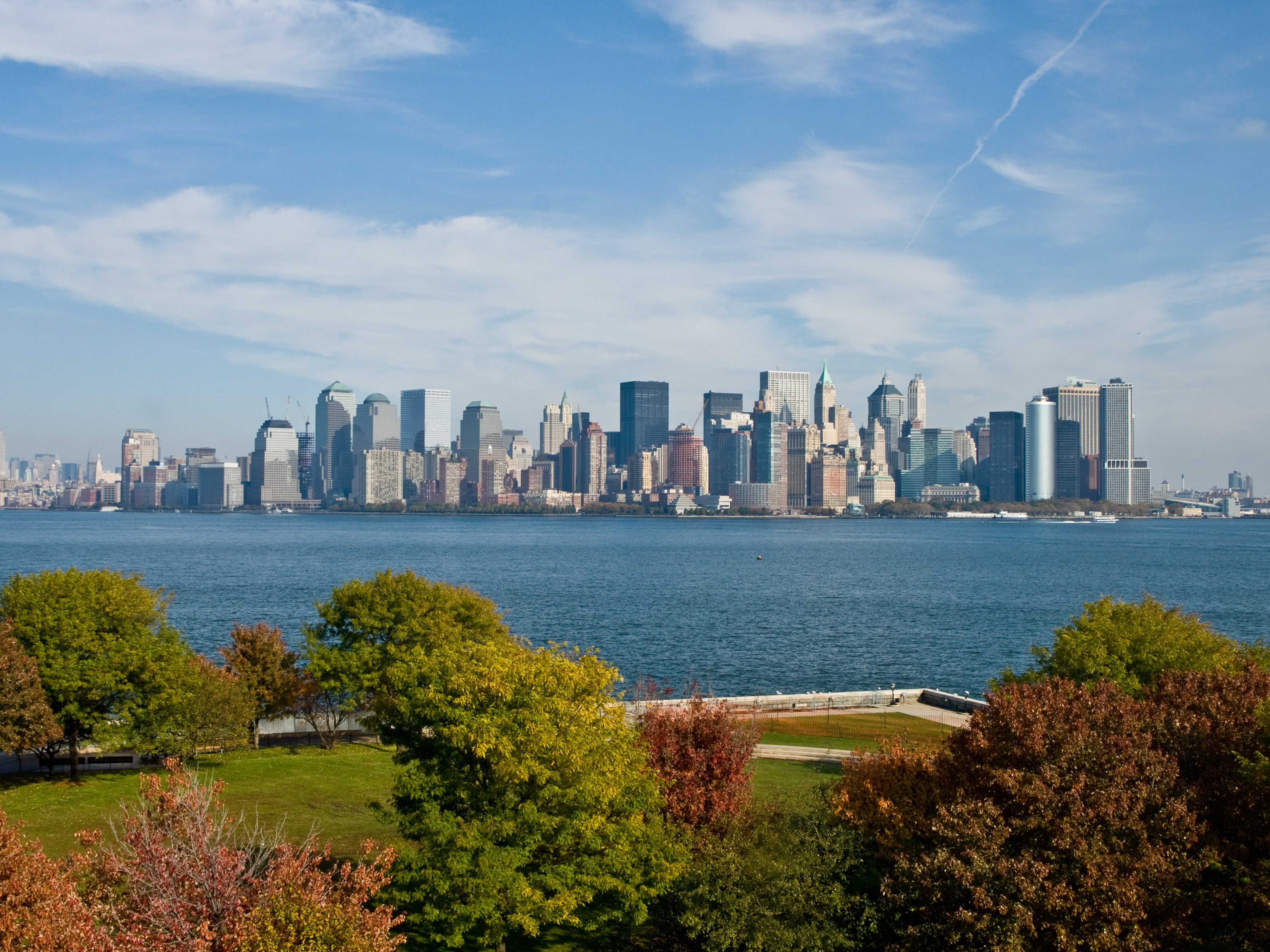
Of course I want to do some typical touristy sight-seeing, too. I am interested in the history of America, about which I recently learned in university. As a result, I plan on going to the New York Harbour to see Ellis Island, the Statue of Liberty and, when I am already there, the skyline of Manhattan. Going by yellow cab to the Downtown and the Central Park is definitely a must-do, as well as seeing Ground Zero, the Empire State Building and the Times Square.

I do not want to spend more than two thousand Euros and because the flight is very expensive, every activity I planned is free. I intend to spend most of the money on food. I want to eat in Turkish, Malaysian, Mexican, Italian, British, Chinese, Indian etc. restaurants, as many as I can afford.

One last thing I want to take a look at is the Columbia University, because it is one of the eight Ivy League Universities and I suppose the campus and the buildings are picturesque. Maybe I will even get the opportunity to enter them, walk around and explore.

I am looking forward to travelling to the Big Apple. I am sure it is going to be worth the long and uncomfortable flight, the strict security checks and the jetlag.

Homework Analysis 2

Paragraph One (Original):

The advantages of online dictionaries

Having looked at a number of monolingual print dictionaries in class this week, I have decided that such dictionaries are not for me. It is arduous to carry a print dictionary around because they are heavy and big, necessarily, because if they were not, there would be even less information offered. Using the internet, in comparison, is much handier and faster. It gives me the opportunity to check on the meaning of a word on various websites, for instance on blogs, in monolingual, bilingual and even picture dictionaries. The amount and variety of online dictionaries is huge, so it is possible for me to learn about the meaning of any idiom crossing my way, additionally I am able to ascertain synonyms, antonyms, collocations and the frequency of the word I searched for, in spoken and written English. In contrast to print ones, a lot of online dictionaries provide audio samples as well as phonetic symbols, so that I can be sure about the right pronunciation. We live in a constantly modernizing world and I want to change with the times, so I definitely prefer online over print dictionaries.

Paragraph Two (Correction):

The advantages of online dictionaries

Having looked at a number of monolingual print dictionaries in class this week, I have decided that such dictionaries are not for me. It is arduous to carry a print dictionary around because they are heavy and big. Using the internet, in comparison, is much handier and faster. It gives me the opportunity to check the meaning of a word on various websites, for instance on blogs as well as in monolingual, bilingual and even picture dictionaries. The amount and variety of online dictionaries is great, so it is possible for me to learn the meaning of practically any idiom I come across. Additionally, online dictionaries make it possible to find synonyms, antonyms, collocations and the frequency of a particular word in spoken and written English. In contrast to print dictionaries, many online ones provide audio samples as well as phonetic symbols so I can be sure about the right pronunciation of the words I look up. We live in a constantly modernizing world and online dictionaries adapt better to this world than print dictionaries do, which is why I choose to use the online versions.


Comparing the original paragraph and the corrected one, I can say that I have to be cautious when it comes to the right choice of vocabulary and that I should proofread my paragraph, in order to not give irrelevant information. Additionally, I have to try harder to write in a more logic way. Of course, I understand, what I am thinking when I am writing the paragraph, but it has to be comprehensible for everyone who reads it.
Every time I correct a paragraph, I learn something new or am reminded of mistakes that I tend to make, such as:
1) You do not check on something, you simply check it. You do not learn about the meaning, you learn the meaning.
2) Register is a very important part in writing. "Huge" and "a lot of" are too informal, a paragraph should be written in a neutral to formal language.
3) I should try to shorten some of my longer sentences, so as to make the paragraph more coherent.
4) "Ascertain" means "to discover", for example, the cause of something, or "to make sure of". You can find synonyms and antonyms in a dictionary, but to ascertain them does not make sense.

Tuesday, December 10, 2013

Christmas Fever

Not even two weeks left, until it is Christmas again!

What do you actually connect with the words “Christmas” and “Advent”? Do you think of a quiet and peaceful time or a rather busy and annoying one?

For me, the Advent season as well as Christmas itself are a very pleasant period of the year indeed. I like to give presents, eat cookies and a large amount of other sweets, receive presents, go to Christmas markets as well as to drive home for Christmas Eve and have the whole family celebrating together. Nevertheless, there is one part of the Advent season that bugs me after some time: Christmas songs are played everywhere all the time. Whether you are in the supermarket or in a shop, whether you turn on the radio or the TV, you will hear Christmas songs in a continuous loop. Not that I do not like them, but they might be played too often.

That is my opinion, of course I know that there are many people who cannot get enough of the "Christmas feeling" and the obligatory songs. Come to think of it, almost every known musician has written a Christmas song, maybe it is a fixed part of a music career...
Anyway, if you do have neither a radio nor a TV and do rarely shop this year for some reason, you may miss the familiar sound of Christmas songs. Do not despair, there are millions of videos available on YouTube and other websites. To give one example, this three hour long compilation of the most famous songs will probably satisfy every Christmas addict. :)


Merry Christmas!
Frohe Weihnachten!
Счастливого Рождества!

Friday, December 6, 2013

Homework Analysis

Being in the process of learning how to write a proper paragraph, it is important for me to, firstly, understand the mistakes I have made, and secondly, know how to correct them.
This is a piece of homework I handed in in class:

The emblem of South Dakota

The one thing that really surprised me about my CLI, Mount Rushmore, was how much effort was put into carving the presidents' faces as a memorial into the Black Mountains. One architect as well as four hundred experienced mountaineers and sculptors worked for fourteen years on the more than eighteen meter high faces. The workers dynamited to remove the largest rocks, but they used drills, chisels and hammers for more detailed work. It is impressing how much attention the sculptors paid to detail, looking for instance at the cubes of granite left inside the eyes' irises in order to make them seem more alive or at the characteristic glasses of Theodore Roosevelt which are present in the monument. The architect of Mount Rushmore even had plans to chisel each president from head to waist, but his early death caused the end of the project and left the sculpture as we know it today. Nevertheless, Mount Rushmore attracts nearly three million visitors a year who travel to South Dakota so as to get as surprised as I am, when travel guides and signs tell them how much work it has been to create this masterpiece.


The corrected paragraph:

The emblem of South Dakota

The one thing that really surprised me about my CLI, Mount Rushmore, was how much effort was put into carving the presidents' faces as a memorial into the Black Mountains. One architect as well as four hundred experienced mountaineers and sculptors worked for fourteen years on the more than eighteen meter high faces. The workers used dynamite to remove the largest rocks, but they used drills, chisels and hammers for more detailed work. It is impressive how much attention the sculptors paid to detail, taking into consideration for instance the cubes of granite left inside the irises in order to make the eyes seem more alive, or the characteristic glasses of Theodore Roosevelt which were carved into the monument too. The architect even had plans to chisel each president from head to waist, but he died before he could do so, consequently, the project and the sculpture were left as we know it today. Despite that fact, Mount Rushmore attracts nearly three million visitors a year who travel to South Dakota and are probably as surprised as I am, when travel guides and signs tell them how much work it was to create this masterpiece.


To talk about the positive aspects first, my original paragraph was cohesive. My supporting sentences as well as the conclusion sentence refer to the statement in the topic sentence and I do not overuse linking words.
There are many mistakes, though:

1) It is more common to say “to use dynamite to remove something”, than to “dynamite something”.
2) It is “impressive”, not “impressing”! If I wanted to use “impressing”, I would have had to write “it is impressing someone”. “Impressive” means that something is impressive in general and it does not need an object.
3) “Taking into consideration” is definitely more formal and sounds more intelligent than “looking”
4) “Left inside the irises to make the eyes seem more alive” fits better, because of possible reference confusions: In my original version, the reader might think that the eyes' irises look more alive because of the cubes of granite. Indeed, it is the eyes that look alive.
5) Punctuation: The comma between “alive” and “or” is necessary because there are two strong clauses joined by a coordinating conjunction (and, or, but, for, nor).
6) “Which are present in” is not a good way to say that the sculptors carved the glasses of Theodore Roosevelt into the Black Mountains. Probably I derived it from the German “präsent sein”. Anyway, it does not work in English.
7) “The architect of Mount Rushmore” → “of Mount Rushmore” is redundant because it would be illogical if I suddenly spoke about an architect of a different monument.
8) “Cause” means “to make something happen” and is a transitive verb. The question is: Can death make something happen? Obviously not. The absence of the architect could have caused the end of the project and the architect is absent because he is dead. “Stop” cannot be used in this context either, because the architect did not die so as to stop the project. That is why I decided to rebuild the sentence in order to avoid the use of one of these verbs.
9) “Nevertheless” is not appropriate because it indicates that the sculpture is not that good because it is not finished, but nevertheless there are many tourists who want to see it. What I actually wanted to convey to the reader is, that the sculpture is brilliant, even without the waists of the presidents.
10) “So as to get as surprised as I am” would mean that tourists go to Mount Rushmore with the intention of being as surprised as I am.
11) “has been”: wrong tense
Working on carving the sculpture is already over; I even know the date it was finished. Because of that, past tense is, in my opinion, more appropriate.
Monday, December 2, 2013

Sita Sings The Blues

Hello again,

I recently saw a very interesting movie which I want to tell you about. It is called Sita Sings The Blues and in the beginning it caught my eye because it had received really good reviews.
After watching the first ten minutes, I realized that this movie is different to anything I have seen before. It is a cartoon about the similarities between the story of a normal couple nowadays and a couple in an ancient Indian myth, the Ramayana. I do not want to tell much about the story of Sita and Rama because I want you to watch it yourself, but a small knowledge about the interesting structure of the film could be helpful if you intend to watch it: As I said, it is a cartoon. Narrators, who are shown as traditional Indian shadow puppets, tell the whole Ramayana, interrupted by short sequences of a contemporary couple. Throughout the movie, the narrators discuss the meaning and the sense of the story in a very sarcastic and funny way. Additionally, to make the film even more interesting, there are some musical episodes in it, that should probably underline the plot.
All in all, I have to say that Sita Sings The Blues is a very interesting, strange and definitely funny movie, even if some songs and parts of the story are told longbreathed. 

By the way, there is even an intermission in the middle of the movie which, in my opinion, is great, although I watched it at home and could have pressed "stop" and "play" as often as I wanted. The simple idea of stopping the film for two and a half minutes amazed me! :)


Saturday, November 16, 2013

YOUPOST 2


The USA – is there actually another country in this world?


When you think of Americans, which stereotypes come to your mind? They are into guns, obesity is a big problem, they are as patriotic as one can be, do you see them as racists or even religious fanatics? Of course there are positive stereotypes, too. US citizens are often seen as optimists and hard-working people who are generous and like to volunteer.
In this blog post, however, I want to engross my mind in one of many typical stereotypes: Geography is not the strength of Americans, mostly because they never leave their own country. The thought of being the most important and powerful state in the world and behaving ignorant against every other culture goes hand in hand with the lack of topographical knowledge. This topic appeals to me because geography is an interesting subject per se and I want to see behind the curtains of a major prejudice which lets Americans look dumb, stupid and proud of it.
There is a great variety of images and videos available on the Internet that are meant to prove the lack of geographical knowledge. Introducing some of the pictures to you, in order to let you know what exactly this stereotype is about, I start with a very disturbing one. It illustrates both ignorance and arrogance against the rest of the world but also a lack of knowledge in terms of cultures and landscapes in their own country:

The following very popular drawing shows a small improvement to the previous one, although there are still some small mistakes, but see for yourself:


It cannot get any worse? No, it cannot indeed. Although I do not think the next one is much better. It demonstrates in an ironic way how the “Rest of the world” is thought to be seen by Americans. Especially the colors are noticeable:


Last but not least, a very detailed insight into the stereotype world around the USA. The key of this map tells us that Americans are proud of having killed Osama bin Laden as well as of the wars they conducted and won. Canadians are seen as morons, Greenland is the home of Santa Claus and Africa consists of sand, gold and diamonds. Saudi Arabia is the most essential part of the world because it offers the USA the opportunity to exploit it so as to keep their status as superpower:


After looking at these examples, a rational thinking world citizen has to ask themselves important questions: Where did this stereotype of ignorance, arrogance and lack of geographical knowledge derive from and is it true?
Americas embarrassing ranking in geography testings (Example one; Example two) is the easiest part to explain. Nobody learns something they are not interested in. Additionally, I found out that most schools in the US focus on subjects that either help pupils to receive a job later on or deal with American culture, history and literature. As a result, it is not surprising that children do not know anything about geography nowadays, having no one who encourages them to learn it.
The reason for this lack of interest in teaching geography lays in both American history and geography itself. In the first one hundred years after foundation, the Atlantic Ocean represented a large barrier that divided the USA from Europe, considering that the latter was the center of power back then. Furthermore, the United States were confined in the south by weak Spanish colonies and in the north by Canada which was occupied by Great Britain, so it initially posed a threat on the US. The years of the British-American War followed and the relationship between America and the United Kingdom improved rapidly after that. Consequently, Canada was not dangerous anymore.

There was enough room for the Americans to expand their territory and they also experienced an industrial boom in the late 19th century. They were busy with trading and expanding as well as looking for new sources in their own, larger and larger growing country. Being that isolated and busy with the execution of all these plans, it is no surprise that citizens were more interested in setting up their state than learning about others.
On the other hand, America had a lot of contact to foreign countries throughout the last century. Beginning with World War One, followed by World War Two and the Cold War, the USA are deeply involved in a war against terrorism today. It would be logical that American citizens have grown interest in geography in all these years of international affairs, but they did not. It seems plausible that the average American does not want to be bothered with war, international business and politics because they are satisfied with their status as a member of a superpower. They have everything they need in their own country, including advanced technology and food resources as well as great environmental variety. The country is almost as big as the whole European continent. That means if an American wants to go on a skiing vacation, they can do it in the USA, if they want to relax on the beach, they can also do it in the USA. Neither a weekend trip to one of the biggest cities in the world, nor a camel ride through a desert are impossible within one state border.
As always, stereotypes are chained to the entirety of a culture, but there are many adventurers among Americans who travel the world. Those who do not go away, in contrast, can definitely refer convincing reasons for their decision.
In conclusion, there is to say that most part of this stereotype is true, but understandable if you do some research on the background of the topic. Yet, it sometimes seems as if Americans try to live in their safe bubble and as long as nothing affects themselves personally, the outside world does not matter. One might think that for instance 9/11, obvious terrorism on American soil, must have woken up the citizens, but as this survey shows, nine out of ten Americans were unable to find Afghanistan on an Asia map after that terrible incident. Maybe because the world out there is so scary, depressing and far away for them.


Monday, November 11, 2013

Airbourne - Vienna - November 9th 2013

Joel O'Keeffe, the singer of Airbourne: “As long as we[the band] are alive and as long as you[the crowd] are alive, rock is not going to die.”

The best way to spend the weekend after an exam is to go to a concert because it distracts from everyday life at university. I was at the Airbourne Concert in Vienna last Saturday and do not regret it. This hard-rock band knows how to entertain people who have to sweat in a crowd with hurting feet and backs. Despite this uncomfortable and crowded situation, the concert audience has the typical, indescribable concert-feeling and the band, especially the lead-singer, does a great job with many guitar-solos and little “acts”. The latter are for example the singer smashing a beer can against his head until it breaks and then throwing it into the crowd or drinking a bottle of wine in one go*, whereas the guitar-solos are extraordinary because some of them take place above or behind the crowd, on speakers and on the scaffolding of the stage. The concert took four hours all in all, two supporting acts included, and I think one can imagine that this leisure time activity diverts the thoughts from the studies. Finally, I am back in Graz again, studying and doing homework, writing blogs and running a household, but I am looking forward to seeing another band at the next concert.


*It is a hard-rock concert. That means as soon as you enter the hall the only valid political system is anarchy. The band members do what they feel like doing and so does the crowd. (Most of) The concertgoers are aware of the fact that this is not a lifestyle to aim for.